

Morocco · Easy
A Two-Week Road Trip Through Morocco: The Atlas Mountains and the Sahara Desert
A classic 14-day road trip through Morocco, starting in Marrakech, crossing the High Atlas Mountains and the Sahara Desert, and passing through Fes and Chefchaouen—covering more than 2,000 kilometers.
- Days
- 14
- Stops
- 11
- Mapped stops
- 11
- Mapped distance
- 2,039.6 km
Share this itinerary
Trip
Day-by-day route
Day 1
1 stopsDay 2
2 stops · 8.3 km · 25 minDay 3
1 stops · 184.6 km · 3 hr 10 minDay 5
1 stops · 386.9 km · 5 hr 50 minDay 8
1 stops · 201.1 km · 3 hr 10 minDay 10
2 stops · 488.7 km · 7 hr 40 minDay 11
1 stops · 2.7 km · 10 minDay 12
1 stops · 194.8 km · 3 hr 40 minDay 14
1 stops · 572.5 km · 7 hr 20 minMap explore
Map explore
Morocco
Morocco
Morocco Medinas and Sahara: A Balanced 10-Day Route
Combine Marrakech, the High Atlas, desert landscapes, and Fes without rushing, with practical advice on transfers, guides, heat, and respectful travel.
10 days
A 2-Week Road Trip in Morocco: The Atlas Mountains and the Sahara Desert
An epic two-week road trip through Morocco, taking you through the country’s most spectacular scenery—from ancient cities like Marrakech and Fes, across the Atl
14 days · Easy
Eid Al Fitr Morocco
Eid al-Fitr in Morocco marks the end of Ramadan, the month of dawn-to-dusk fasting, and begins on the first day of Shawwal in the Islamic lunar calendar. The ce
Date pending official confirmation
The Ultimate 2026 Morocco Travel Itinerary
A comprehensive tour of Morocco covering all the major highlights—the Old City of Marrakech, the dunes of the Sahara, the ancient capital of Fes, the blue town
10 days · Easy
Marrakech Rose Festival
In Morocco’s Kelaat M’Gouna valley, Marrakech’s Rose Festival celebrates the annual May harvest of Damascus roses. The air fills with their fragrance, while par
Date pending official confirmationRelated reading
Discover places worth the detour
Morocco
A Two-Week Road Trip Through Morocco: The Atlas Mountains and the Sahara Desert
Day 1
Marrakech - Jemaa El Fnaa
View in Google Maps
Day 2
Bahia Palace
Bahia Palace in Marrakech is a 19th-century palace complex built for Si Moussa, the Grand Vizier of the Sultan, and later expanded by his son Ba Ahmed. Its sequence of courtyards, gardens, and 160 lavishly decorated rooms showcase the finest traditional Moroccan craftsmanship — carved stucco, painted cedarwood ceilings, zellij tilework, and mosaic fountains. The palace's name means Beautiful or Brilliant, and its intimate maze of spaces fulfills that promise.
View in Google MapsMajorelle Garden
Majorelle Garden is one of Marrakech's most enchanting and visited attractions, a botanical garden and artist's landscape created by French painter Jacques Majorelle over almost 40 years from 1924. The garden is famous for its vivid cobalt blue villa — now housing the Berber Museum — surrounded by lush exotic plants, bamboo groves, and cactus beds. It was acquired, restored, and saved from a real estate development by fashion designers Yves Saint Laurent and Pierre Bergé in 1980, and Saint Laurent's ashes are scattered in the garden's rose garden.
View in Google Maps
Day 3
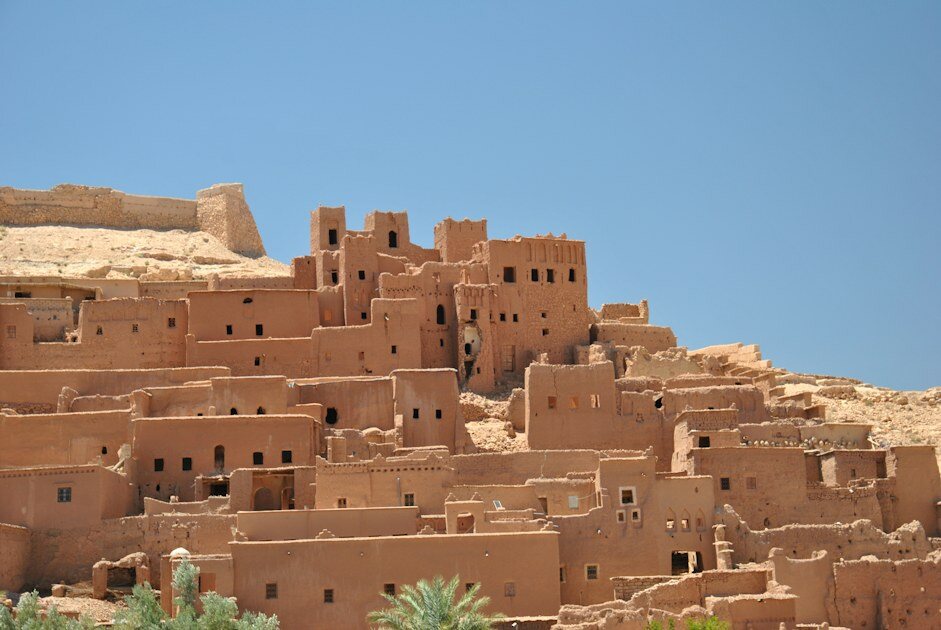
Ait Benhaddou UNESCO Kasbah
Aït Benhaddou is a breathtaking UNESCO World Heritage ksar (fortified village) rising from the banks of the Ounila River in southern Morocco's pre-Saharan landscape. Built from earthen clay and straw in the 11th century, its honey-colored kasbahs and towers once served as a staging post on the trans-Saharan trade route. It has starred in numerous films including Lawrence of Arabia and Game of Thrones.
View in Google Maps
Day 5
Erg Chebbi Dunes - Merzouga
View in Google Maps
Day 8
Todra Gorge
Todra Gorge is a dramatic natural geological feature , showcasing the powerful forces that have shaped the landscape over millennia. The area draws visitors interested in Earth's geological heritage and offers a striking encounter with the raw natural forces that continue to define this remarkable environment.
View in Google Maps
Day 10
Fez el-Bali Old Medina
Fez el-Bali is the UNESCO-listed old medina of Fes, one of the world's largest and most complete intact medieval cities, a 9th-century maze of 9,400 streets, lanes, and alleys where cars are unknown and donkeys are still the primary transport. The medina's 14,000 alleys house 365 mosques, ancient madrasas, hammams, and working traditional crafts workshops in a living city that has functioned continuously since its founding in 789 AD. Getting genuinely lost here is virtually guaranteed and deeply rewarding.
View in Google MapsAl-Qarawiyyin Mosque
Al-Qarawiyyin Mosque in Fes, Morocco, is the world's oldest continuously operating institution of higher learning, founded in 859 CE by Fatima al-Fihri. The mosque complex contains 14 prayer halls and can accommodate up to 20,000 worshippers. The adjacent Al-Qarawiyyin University, recognized by UNESCO as the world's oldest degree-granting institution, attracted medieval scholars including Ibn Khaldun and profoundly influenced the development of higher education worldwide.
View in Google Maps
Day 11
Chouara Tanneries
The Chouara Tanneries of Fes are Morocco's most extraordinary working relic, where hides are still processed by hand in the same round stone dyeing vats using plant-based dyes as in medieval times. The kaleidoscopic spectacle of the vats filled with saffron, indigo, poppy red, and cedar brown is best viewed from the leather shop galleries above. Workers wading through the dye baths in this centuries-old choreography of craft is one of Africa's most unforgettable sights.
View in Google Maps
Day 12
Chefchaouen Blue Medina
Chefchaouen is Morocco's most photogenic city, a mountain town in the Rif Mountains whose entire old medina is famously painted in shades of blue and white, creating a dreamlike setting unlike anywhere else in the world. The blue paint tradition, established by Jewish refugees in the 15th century, now covers every wall, stair, and doorway, contrasting with the red clay mountains above. The relaxed mountain atmosphere, excellent hiking, and extraordinary photographic opportunities make Chefchaouen Morocco's most visited city after Marrakech and Fes.
View in Google Maps
Day 14
Marrakech - Return
View in Google Maps